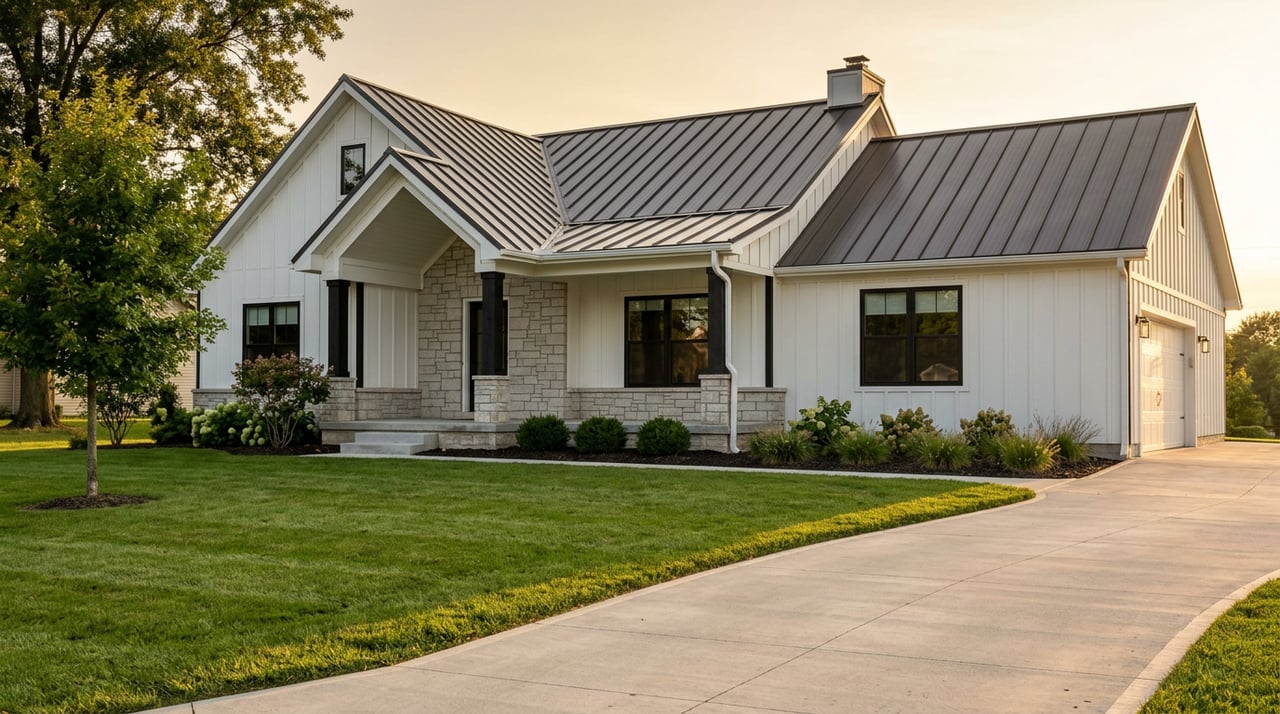
Pull up two Mayfield listings this month at the same asking price. One sits on a quiet street built before 1980, close enough to walk to Court Square. The other is a new build on a fresh lot at Ayly Estates, the subdivision going up on Graves County's edge with room for custom homes on cul-de-sac parcels. On the MLS sheet, they look like a coin flip. Same bedrooms, similar square footage, same list price down to the thousand.
They are not the same purchase. Insurance quotes are another cost to compare before closing. In Graves County, nearly five years after the December 2021 tornado, insurance is one factor buyers can compare alongside a home's price.
How price and insurance costs fit into the comparison
Search three different sources for Mayfield's median home price this year and you'll get three different answers, and the spread reflects the different measures each source tracks. Closed-sale tracking put Mayfield's median at $170,907 in June 2026, down 5.8% from a year earlier. Active-listing data tells a different story, with a median list price closer to $235,000 and homes sitting a median 62 days before going under contract, a gap we've written about before when explaining why list price and closed price answer different questions. A third snapshot from earlier this year showed a sale-to-list ratio under 99%, meaning sellers are increasingly accepting under asking rather than over it.
None of that spread is unusual for a small market with a low sales count. What's unusual is what happens after the sale closes. Two buyers who each paid close to median can walk away with insurance bills that differ by hundreds of dollars a year and rebuild coverage that differs by tens of thousands of dollars, and the reason has nothing to do with the number on the settlement statement.
How insurance coverage can affect ownership costs
Graves County carries what insurers now treat as a documented tornado corridor rating, a direct consequence of the EF-4 that tore through Mayfield on December 10, 2021. That rating doesn't change what a house is worth. It changes how the house is priced to insure, and it does so through two mechanisms that rarely come up until a buyer is already under contract.
The first is the wind and hail deductible. Most Kentucky homeowners policies write this as a flat dollar figure, but in Graves County, Boswell Insurance Agency, which has written policies through the post-tornado recovery, notes that wind and hail deductibles in the county commonly run 1% to 2% of the dwelling's insured value rather than a flat number. On a $250,000 dwelling limit, that is $2,500 to $5,000 out of pocket before the carrier pays a dime on tornado or hail damage, a figure that scales with the home's coverage amount rather than staying fixed. A buyer comparing two homes at the same price needs to ask what each one is actually insured for, because that number, not the sale price, is what the deductible is calculated against.
The second factor concerns code-upgrade coverage. Standard Kentucky policies include Ordinance or Law coverage capped at 10% of Coverage A, the part of the policy that pays for code upgrades required when you rebuild. Building codes have tightened since many Graves County homes were framed, covering wind bracing, egress windows, and updated electrical and plumbing standards. Rebuild to current code after a total loss, and that 10% cushion can run out fast. The agency's own statewide guidance uses a plain example: on a $300,000 home, 10% of Coverage A is $30,000, which sounds substantial until an actual code-upgrade quote comes back closer to $75,000. That shortfall is the same for every Kentucky homeowner, but it lands harder on Mayfield's older stock, where more of the housing predates the code changes that followed the tornado.
Why the age of the house is the number that actually matters
This is where the two hypothetical listings stop looking like a coin flip. A home near Court Square built decades ago carries more exposure to that Ordinance or Law gap simply because more of its systems predate current code. A new build at Ayly Estates was framed to current standards from the start, so the gap between its Coverage A limit and an actual rebuild cost is narrower before a policy is even written.
None of this means the older home is a bad purchase. It means the real comparison a buyer should run isn't list price against list price. It's replacement cost against Coverage A, and code-upgrade exposure against the Ordinance or Law percentage written into the quote. That is exactly the kind of number a defensible valuation is built to surface, and it's a conversation worth having with an appraiser before you write an offer, not after inspection turns up knob-and-tube wiring or a 1970s panel box.
The recovery still shaping what gets insured
Mayfield's rebuild is not finished, though pieces of it have landed. The Mayfield Messenger reported that the Graves County Administrative Building, replacing the courthouse destroyed in the tornado, broke ground in December 2023 with a projected 18-to-24 month build, which put its expected completion around late 2025. The report also said First Kentucky Bank's Sixth Street location underwent a renovation tied to its 125th anniversary, adding a new drive-through and rear plaza entrance, an early sign of private investment returning to downtown alongside the public rebuild we've tracked in our downtown timeline coverage.
The bigger public project is still ahead. Rebuild Mayfield, the streetscape effort funded by a $25 million federal RAISE grant covering 2.5 miles of downtown roadway, remains in preliminary design, with construction tentatively expected sometime between 2026 and 2028. The Kentucky Transportation Cabinet has a public information meeting scheduled for September 15 to update residents on those plans, timed close to the tornado's fifth anniversary this December. Property owners can review the design alternatives directly at rebuildmayfield.com.
That ongoing recovery is a reason for cautious optimism about the town's trajectory, and it's also a reason insurance underwriting in Graves County isn't going to loosen quickly. Catastrophic, named-event losses like the 2021 outbreak don't typically spike an individual policyholder's rate on their own, but they do influence how carriers price an entire county going forward. A buyer comparing Mayfield to Murray or Benton on price should also compare insurance quotes, since carriers may account for local risk in their pricing.
What to ask before you write an offer
A buyer working through Mayfield listings this fall should get specific answers to a short list of questions before signing anything, ideally with an agent and an insurance producer in the room together:
- What is the home's actual replacement cost to rebuild at today's material and labor prices, not its list price or its last appraised value?
- What is the wind and hail deductible written as a percentage of dwelling coverage, and what does that translate to in dollars on this specific home?
- What percentage of Coverage A is allocated to Ordinance or Law coverage, and does that match the age and systems of the house?
- What is the Additional Living Expense limit, and is it enough to cover a 12-to-24-month rebuild timeline if the home becomes uninhabitable?
Those four answers, more than the list price, tell you what you're actually buying.
A few questions we hear often
Does this only apply to homes damaged in the 2021 tornado? No. The corridor rating and the Ordinance or Law gap apply to underwriting across Graves County, whether or not a specific home sustained damage. It's a county-level pricing factor, not a property history flag.
Will insurance costs in Mayfield come down as the rebuild finishes? There's no evidence of that yet. Carriers price for documented risk over a longer horizon than any single construction timeline, and the Rebuild Mayfield streetscape work is still in the planning stage as of this writing, with construction tentatively set for sometime between 2026 and 2028.
Should I avoid older homes in Mayfield because of this? Not necessarily. An older home with updated systems and adequate Ordinance or Law coverage can be a sound purchase. The point is knowing the number before closing, not after a claim.
If you're weighing a Mayfield property against another West Kentucky town, or trying to figure out what a specific house is really worth once rebuild-cost exposure is priced in, that's a conversation best had with someone who does valuation work daily, not a portal estimate. HRE Advisors combines local market knowledge with in-house appraisal expertise to help buyers and sellers see the full picture before they sign anything. Request a Market Valuation & Strategy session and we'll walk through the numbers that actually matter on your specific address.
This article is general information, not legal, tax or financial advice. Consult a qualified professional about your situation.